Showing posts with label forward head posture. Show all posts

Wednesday, February 4, 2015

1. The Superficial Back Line

Welcome to the first myofascial meridian!  

The Superficial Back Line

     I personally struggle with this guy.  Tight calves (gastrocnemius), knotted-up hamstrings, shortened erectors in the lumbar area, which means - you guessed it - all the connective tissue (fascia) that encase those muscles and helps keep them tacked down the my bones is nice and tied up, too.  I can definitely thank the Superficial Back Line for my low back issues.

So, if you have pain or tightness along your spine, tightness in the back of your neck, or have trouble touching your toes when you're doing all those awesome stretches I've suggested, you can bet that issues lie within the SBL.

Let's go ahead and go over all the bits and pieces of the SBL so we can get right to the solution to those possible issues.

- - - - -

     The superficial back line (SBL) runs along the entire posterior surface of the body, from the toes all the way up to the brow.  It's postural function is to keep the body upright.  It is what allows us to sit up straight and walk tall.


Each meridian consists of muscles + connective tissues (i.e. ligaments, tendons, fascial sheets) and attach to specific bony landmark to allow mobility through the entire track. 


Muscles within the SBL:
Erector Spinae
Hamstrings
Gastrocnemius
Short toe flexors


Connective tissue (ligaments, tendons, fascial sheets) that make up the rest of the SBL:
Epicranal fascia
Sacrotuberousligament
Achilles tendon
Plantar fascia

The bony landmarks that the SBL anchors to:
Frontal bone
Suboccipital ridge
Occipital ridge
Scarum
Ischial tuberosity
Condyles of the femur
Calcaneus
Plantar surface of the toes


Common postural deviations associated with the SBL are:
Hyperextension of the knees
Lordosis
Hamstring shortness
Hyperextension of the upper cervial spine


Some stretches that address parts of and the entire SBL:
Seated forward bend (A)
Forward bend (B)
Downward dog (C)
Plow pose (D)
Child's pose (not pictured)


Also, laying on your stomach stretched over a large exercise ball (like so) aids in relaxation of the entire SBL.


- - - - -

So...?  How was that?  Do you guys have a better idea of what myofascial meridians are now?
Shoots me any questions or comments you might have here or here (Facebook) or here (Twitter).

Next week, I'll be going over the Superficial Front Line!

Saturday, July 26, 2014

Neck Pain

Hey guys!
I hope you are all doing well, and have had an amazing summer!

     With all the rain happening off and on, everyone’s allergies have been miserable, including mine.  I’d had a horrible headache for almost a week, with NetiPot, Epsom salt baths, and my usual allergy arsenal barely touching it.

     So! I poured over all my reference books for a good while before I turned to YouTube to look for cervical spine stretches (I know I talked about TMJ and Forward Head Posture in one of my previous posts, but I couldn’t even get comfortable enough to do those stretches!)  I finally found this video by Dr. Paula Moore:

     It has worked WONDERS for not only my neck pain, but even pain I was unaware of in my mid back and arms!  After three days of doing her exercise/stretch every time I thought about it or found myself leaning my chin on my hand at the computer, I was loose enough to do these amazing neck stretches.


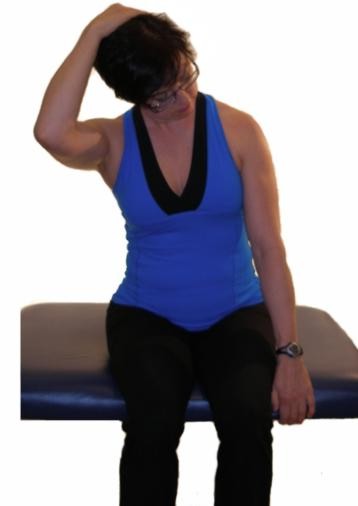
Do them.  Every time you find yourself craning your neck forward or propping it way too high when watching tv; straighten up, stretch the crown of your head as if you are trying to touch the ceiling, and do.these.stretches.

They will change your cervical spine’s life. :)

You can follow my Relief: Shoulder, Neck, and Head Aches board on Pinterest for more upper back pain solutions!

Friday, May 30, 2014

TMJ & Forward Head Posture

     Hey guys!  The month of May has been a fabulous, crazy, fast month for me, hence my lack of posts the previous couple of weeks.  I want to thank everyone who helped with the grand opening party and came out to support us.  You are all amazing, and I am so grateful to have you in my life!  For future reference, if I ever take off and leave you guys without prompts, you can always visit my Pinterest for stretches, exercises, health tips, etc.
     _______________________________________________________________

     This week I'm going to cover a bit about the TMJ (temporomandibular joint), TMD (temporomandibular disorders), and what role forward head posture has in the mix.

Temporomandibular joint and muscle disorders (TMJ/TMD) are the symptoms of tension or injury to the chewing muscles and joints connecting your jaw (mandible) to your skull.

Here you can see the superficial muscles (the masseter and temporalis), a cut away to view the deep muscles (the pterygoids), and where the muscles insert on the mandible (jaw bone).
(You can view a larger version of this picture here!)

Elevation of the Mandible                                                     Muscles Responsible
 Masseter, Temporalis, Medial Pterygoid
Retraction of the Mandible
Temporalis
Protraction of the Mandible
Medial & Lateral Pterygoid
Lateral Deviation of the Mandible
Medial & Lateral Pterygoid

And here is how forward head posture can pull your entire spine out of alignment:
Watch this video- It's a great link on how to work with TMJ pain with Erik Dalton.  He explains a few different muscles I haven't covered yet, but goes into greater detail with forward head posture and TMJ/neck pain.
     _______________________________________________________________

To put it simply, when your head moves forward from slumping over your desk all day, the muscles attaching to your jaw become shortened, retracting your jaw (see the yellow circle above.)  Clenching/grinding your teeth tightens these muscles as well.  Your jaw gets pulled into this area, creating tension and pain due to limited range of motion in your temporomandibular joint.  You can perform self massage in or outside of your mouth to release some of these muscles, as well as along your temples and behind your ears.

Here are some TMJ trigger points and pain patterns.  You can apply pressure to the black X areas while gently, slowly opening and closing your mouth.  Repeat 10 times.

Masseter:                                                            Temporalis:
You can also use a wine cork to relax your jaw by placing it between your teeth.  Relax and hold for 20 seconds. Repeat 3 to 5 times.

To relieve forward head posture, you can turn your head to the left and feel your right SCM pop up.  Gently pinch it between your pointer and thumb on these black X areas and slowly tilt your head back as far as you are comfortable with.  Hold each for 10 seconds and release.

SCM:
You can also place the tips of your fingers on the insertions (at the inside edge of your collarbones) and gently tilt your head backwards to stretch these guys!


And I'll leave you with this.  Have a wonderful weekend!!!